Nasolabial Folds and Marionette Lines: How to Improve Their Appearance Without Surgery
Date
Written by
Marsha Bensussen
Revised by
Quenby Erickson, DO, FAAD, FACMS
You've noticed some lines deepening from your nose toward the corners of your mouth, or creases extending from your mouth toward your chin. You're not alone. Nasolabial folds and marionette lines are a common part of facial aging. In this guide, we'll explore why they develop and what non-surgical options can help.
Nasolabial folds and marionette lines can develop due to midface volume loss, collagen decline, and repeated facial movement. While dermal fillers restore lost volume, collagen-remodeling treatments like Sofwave™ take a different approach by improving the appearance of lines and wrinkles through collagen regeneration.
What Are Nasolabial Folds and Marionette Lines?
Nasolabial folds: nose to mouth
Nasolabial folds begin beside the nose and travel diagonally toward the corners of the mouth. They are often called smile lines or laugh lines because they become more visible with facial movements such as smiling or laughing.
Marionette lines: mouth to chin
Marionette lines begin at the corners of the mouth and extend toward the chin. They sit below the mouth and may reflect lower-face changes as well as repeated movement around the lips.
What Causes Nasolabial Folds and Marionette Lines?
Nasolabial folds and marionette lines have several possible causes, including changes in facial volume, dermal support, repeated movement, and external factors.
Midface volume loss
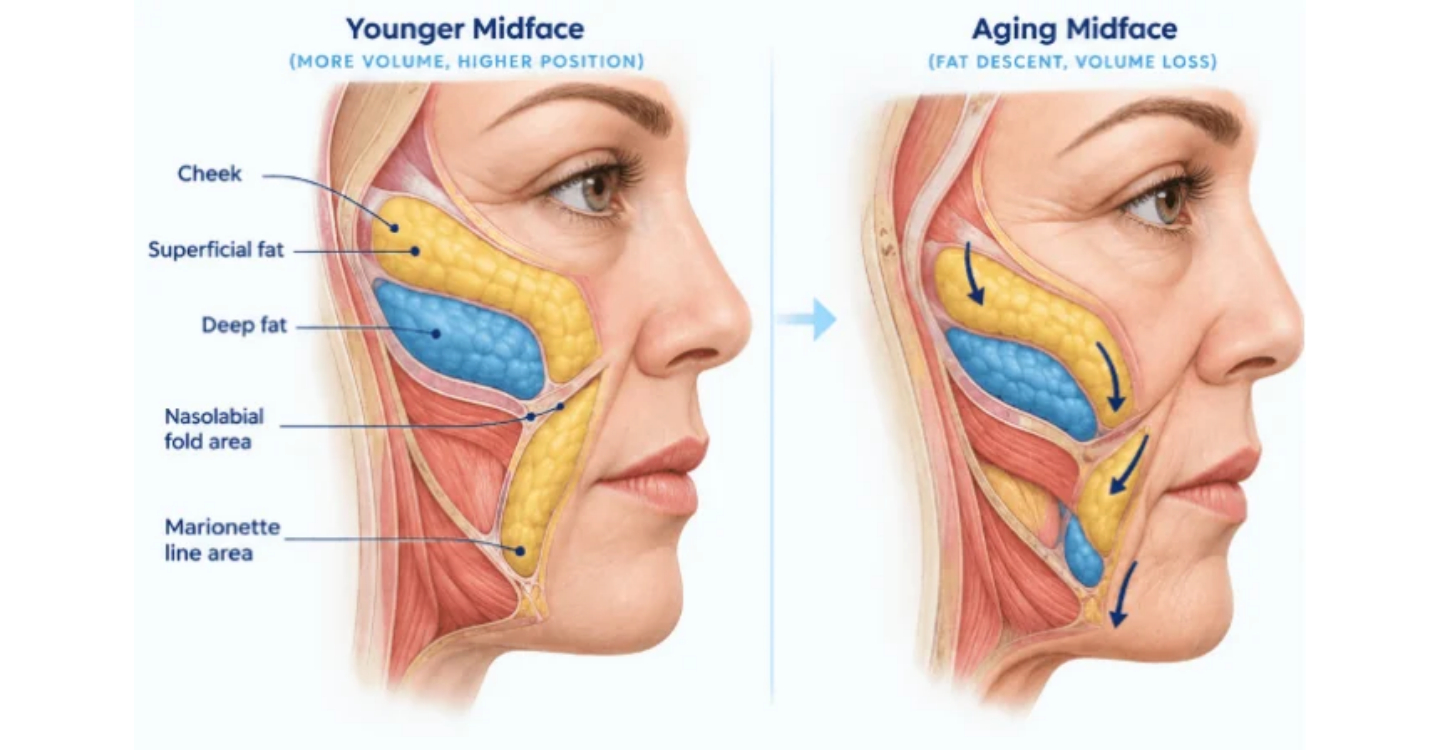
Facial fat sits in distinct superficial and deep compartments that can change with age. Research found significant volume loss in both layers of the midface over an average of 11.3 years, with proportionally greater loss in the deep fat compartments. As midface support changes, the transition between the cheek and the area beside the mouth may become more pronounced, making nasolabial folds more visible.
Weight loss can also affect facial volume. Recent radiographic research in people using GLP-1 receptor agonists found that midface volume loss occurred primarily in the superficial fat compartments, with an average 7% reduction in midfacial volume for every 10 kg of total weight lost. These findings suggest that the pattern of volume change associated with substantial weight loss may differ from age-related facial volume changes.
Collagen and elastin decline
Collagen provides structural support to the skin, while elastin helps it return to its natural position after movement. As collagen and elastin decline with age, folds that once appeared mainly with facial expressions can become more noticeable even at rest.
Gravity, expression, and lifestyle
Repeated expressions can make established lines more noticeable. Sun exposure contributes to collagen breakdown, and smoking is associated with earlier facial wrinkling. Gravity also acts on tissues whose underlying support has changed over time.
Non-Surgical Treatment Options for Nasolabial Folds and Marionette Lines
Different non-surgical treatments target different causes of nasolabial folds (also called smile lines or laugh lines) and marionette lines. Some restore lost volume, while others improve the appearance of lines and wrinkles.
Skincare: a supportive role
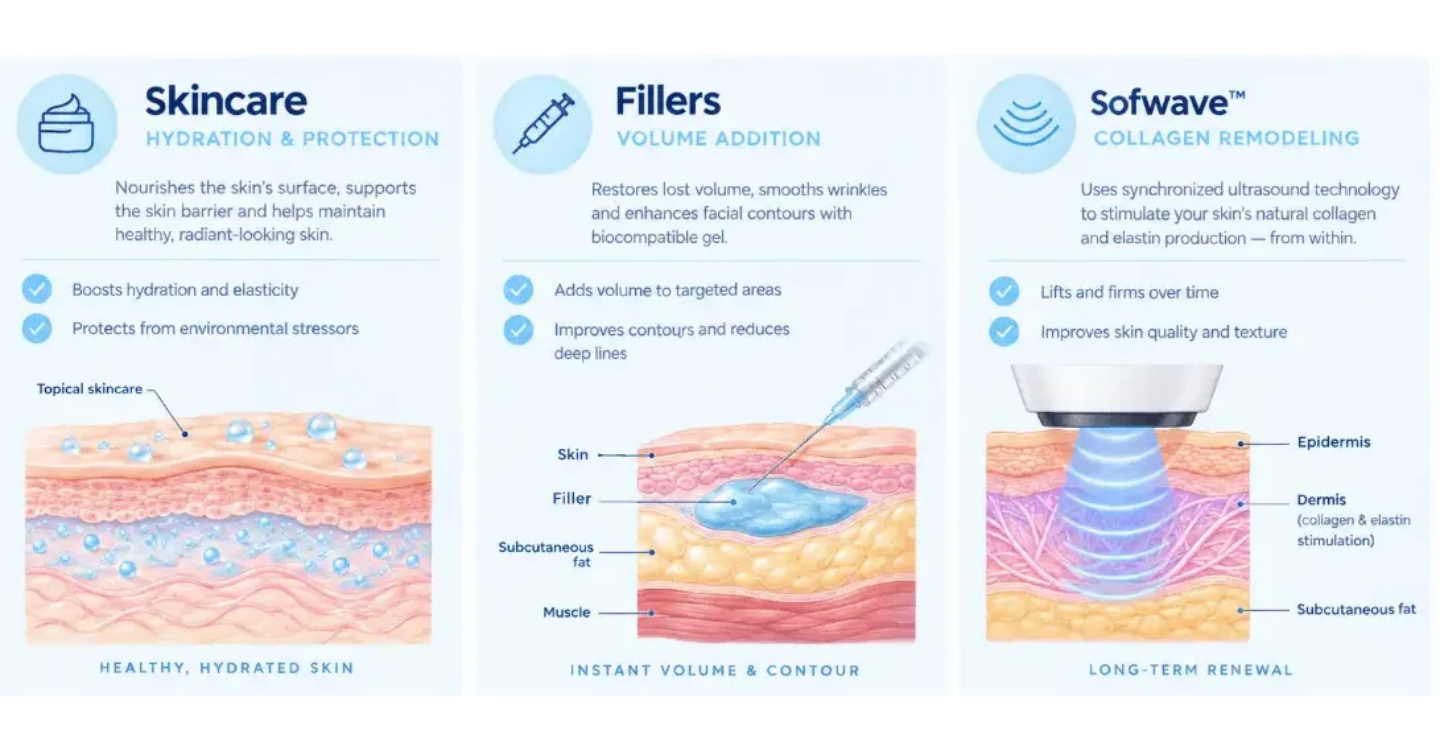
Skincare can support hydration and help protect the skin from additional UV-related changes. Topical ingredients such as retinoids, vitamin C, and niacinamide may help address some signs of photoaging, while retinoids such as retinol have evidence for improving the appearance of fine wrinkles.
However, topical care has limited influence on deeper nasolabial folds or marionette lines and cannot replace lost facial volume.
Dermal fillers: adding volume
Dermal fillers add volume and may be used when volume loss contributes to nasolabial folds or marionette lines. Depending on facial anatomy, a provider may place filler in or around the areas contributing to the fold. Most fillers are temporary, and the appropriate material, amount, and placement vary from individual to individual.
Energy-based collagen remodeling: lines and wrinkles
Energy-based treatments work differently from fillers. They deliver controlled energy into selected skin layers to support collagen remodeling and improve the appearance of lines and wrinkles. They do not replace lost facial volume.
How Sofwave™ Improves the Appearance of Facial Lines and Wrinkles
Sofwave™ is a non-invasive, needleless ultrasound treatment that is FDA-cleared to improve the appearance of facial fine lines and wrinkles. Sofwave™ stimulates collagen remodeling to improve the appearance of lines and wrinkles. It does not add facial volume.

SUPERB™ Ultrasound in the Mid-Dermis
Sofwave™ uses Synchronous Ultrasound Parallel Beam Technology (SUPERB™) to deliver controlled ultrasound energy to the mid-dermis at a depth of approximately 1.5 mm, promoting collagen remodeling.
In a 2023 lower-face study, Hongcharu, Boonchoo, and Gold used Antera 3D imaging to measure the depression volume of nasolabial folds and marionette lines after a single Sofwave™ treatment. Mean depression-volume changes were statistically significant at both one and three months compared with baseline, and reductions in nasolabial folds and marionette lines were observed in more than 60% of participants as early as one month. The study did not find a significant additional mean change between the one- and three-month assessments.
More recent research provides additional evidence of dermal remodeling following synchronous parallel ultrasound treatment. A 2025 clinical and histologic study by Suh et al. reported a significant increase in elastic fibers following facial treatment, while a separate 2025 study by Carruthers et al. found continuing collagen and elastin remodeling in human skin biopsies through 10 months after treatment.

Fillers and Collagen Remodeling: Complementary Approaches
Fillers add volume, whereas Sofwave™ improves the appearance of facial lines and wrinkles through collagen remodeling. If both are used, Sofwave™ should be performed first as the base treatment, with fillers administered afterward at a separate appointment. When energy-based devices and hyaluronic acid fillers are combined, applying the energy-based treatment before filler injection is generally recommended to reduce the risk of filler degradation, according to a 2024 paper by Yi. Suitability and timing should be determined by the treating physician based on individual anatomy, medical history, and treatment goals.
Read more about lifting the lower face without surgery.
What to Expect From Sofwave™ for Nasolabial Folds and Marionette Lines
A Sofwave™ session typically takes 30–45 minutes, and a topical anesthetic may be used for comfort. The treatment is non-invasive and has minimal downtime.
Results develop gradually as collagen remodeling progresses. The Hongcharu study assessed the lower face at one and three months, so individual timelines may vary.
Find a Sofwave™ Provider
You've now learned how nasolabial folds and marionette lines develop, and which treatment options address them. If you're considering Sofwave™ for your lower face, a qualified provider can determine whether it's right for your anatomy and goals. Find a Sofwave™ provider near you.
Frequently Asked Questions
What causes nasolabial folds?
Nasolabial folds usually result from several changes, including midface volume loss, shifts in facial fat compartments, collagen and elastin decline, repeated expression, sun exposure, and gravity. The relative contribution of each factor differs.
What is the difference between nasolabial folds and marionette lines?
Nasolabial folds extend from the sides of the nose toward the corners of the mouth. Marionette lines begin at the corners of the mouth and run toward the chin. They may appear together, but they occupy different parts of the lower face.
Can nasolabial folds be improved without surgery?
Yes. Options include dermal fillers for volume-related folds, energy-based treatments for the appearance of lines and wrinkles, and skincare that supports hydration and sun protection. The appropriate approach depends on the anatomy contributing to the fold.
Does Sofwave™ add volume to nasolabial folds?
No. Sofwave™ does not add or replace facial volume. It supports collagen remodeling and is FDA-cleared to improve the appearance of facial fine lines and wrinkles. The treating physician should determine which treatment approach is appropriate based on individual anatomy, medical history, and treatment goals.
How soon can results in nasolabial folds and marionette lines become visible?
Results develop gradually. In the Hongcharu study, statistically significant improvements in nasolabial folds and marionette lines were measured as early as one month after a single treatment and again at three months. Individual timelines and results may vary.
How long do Sofwave™ results for nasolabial folds and marionette lines last?
In a 2026 facial study by Chung et al., improvements in facial wrinkles lasted up to nine months in some participants, although nasolabial folds and marionette lines were not assessed separately. In the Hongcharu study, results in these areas were measured through three months. Individual results and duration may vary.
Can Sofwave™ be combined with fillers?
Potentially. If the treating physician determines that both treatments are appropriate, Sofwave™ should be performed first as the base treatment, with fillers administered afterward at a separate appointment. The treating physician should determine the timing based on individual anatomy, medical history, treatment goals, and the treatments involved.
Wrapping Up
Nasolabial folds and marionette lines are a natural part of aging, but they don't have to define how you feel about your appearance. Whether you choose skincare, fillers, Sofwave™, or a combination, understanding what each treatment can and cannot do will help you and a qualified provider build a plan tailored to your anatomy and goals.
References
- American Academy of Dermatology. 11 ways to reduce premature skin aging. https://www.aad.org/public/everyday-care/skin-care-secrets/anti-aging/reduce-premature-aging-skin
- American Academy of Dermatology. Fillers: Overview. https://www.aad.org/public/cosmetic/wrinkles/fillers-overview
- Berry K, Hallock K, Lam C. Photoaging and Topical Rejuvenation. Clinics in Plastic Surgery. 2023;50(3):381–390. doi:10.1016/j.cps.2022.12.003. PMID: 37169404. https://pubmed.ncbi.nlm.nih.gov/37169404/
- Boehm LM, Morgan A, Hettinger P, Matloub HS. Facial Aging: A Quantitative Analysis of Midface Volume Changes over 11 Years. Plastic and Reconstructive Surgery. 2021;147(2):319–327. doi:10.1097/PRS.0000000000007518. PMID: 33165293. https://pubmed.ncbi.nlm.nih.gov/33165293/
- Carruthers J, Benitez Roig V, McDaniel DH, et al. Synchronous Parallel Ultrasound Induces Long-Term Extracellular Matrix Remodeling of Human Skin. Dermatologic Surgery. 2025;51(9S):S58–S64. doi:10.1097/DSS.0000000000004793. PMID: 41405933. https://pubmed.ncbi.nlm.nih.gov/41405933/
- Chung MMH, Wong CSM, Chan MWM, Shek SYN, Yeung CK, Chan HHL. Evaluating the Use of High-Intensity Non-Focused Ultrasound Treatment to Improve Skin Laxity and Facial Wrinkles in Asian Patients. Lasers in Surgery and Medicine. 2026;58(8):637–643. doi:10.1002/lsm.70153. PMID: 42226470. https://pubmed.ncbi.nlm.nih.gov/42226470/
- Gold MH, Biron J. Efficacy and safety of high-intensity, high-frequency, non-focused ultrasound parallel beams for facial skin laxity. Journal of Cosmetic Dermatology. 2024;23(1):117–123. doi:10.1111/jocd.16098. PMID: 38031530. https://pubmed.ncbi.nlm.nih.gov/38031530/
- Hongcharu W, Boonchoo K, Gold MH. The efficacy and safety of the high-intensity parallel beam ultrasound device at the depth of 1.5 mm for skin tightening. Journal of Cosmetic Dermatology. 2023;22(5):1488–1494. doi:10.1111/jocd.15672. PMID: 36757157. https://pubmed.ncbi.nlm.nih.gov/36757157/
- Lin L, Chen X, Liu C, et al. Comparative efficacy of topical interventions for facial photoaging: a network meta-analysis. Scientific Reports. 2025;15(1):26889. doi:10.1038/s41598-025-12597-0. PMID: 40707570. https://pubmed.ncbi.nlm.nih.gov/40707570/
- Liao D, Prasad A, Bloom JD. Use of Ultrasound in Face and Neck Rejuvenation. Facial Plastic Surgery. 2026. doi:10.1055/a-2854-6601. PMID: 41985490. https://pubmed.ncbi.nlm.nih.gov/41985490/
- Mnajjed L, Mims MM. Interest in Facial Volume Restorative Procedures With the Rise in “Ozempic Face”: A Google Trends Analysis. Plastic and Reconstructive Surgery–Global Open. 2025;13(11):e7282. doi:10.1097/GOX.0000000000007282. PMID: 41255744. https://pubmed.ncbi.nlm.nih.gov/41255744/
- Rohrich RJ, Pessa JE. The fat compartments of the face: anatomy and clinical implications for cosmetic surgery. Plastic and Reconstructive Surgery. 2007;119(7):2219–2227. doi:10.1097/01.prs.0000265403.66886.54. PMID: 17519724. https://pubmed.ncbi.nlm.nih.gov/17519724/
- Sharma RK, Vittetoe KL, Barna AJ, et al. Radiographic Midfacial Volume Changes in Patients on GLP-1 Agonists. Otolaryngology–Head and Neck Surgery. 2025;173(2):360–366. doi:10.1002/ohn.1209. PMID: 40407186. https://pubmed.ncbi.nlm.nih.gov/40407186/
- Suh DH, Lee SJ, Song KY, Ahn HJ, Shin MK. High-Intensity, Parallel Ultrasound Tightening of Facial Skin: Clinical and Pathologic Results. Journal of Cosmetic Dermatology. 2025;24(2):e16670. doi:10.1111/jocd.16670. PMID: 39530193. https://pubmed.ncbi.nlm.nih.gov/39530193/
- U.S. Food and Drug Administration. Dermal Fillers (Soft Tissue Fillers). https://www.fda.gov/medical-devices/aesthetic-cosmetic-devices/dermal-fillers-soft-tissue-fillers
- Yi KH. Treating energy-based devices and hyaluronic acid filler injection together? Skin Research and Technology. 2024;30(4):e13716. doi:10.1111/srt.13716. PMID: 38634184. https://pubmed.ncbi.nlm.nih.gov/38634184/